How to Protect Your Teeth from Cavities: Expert Tips for a Healthier Smile
That sudden sharp pain when you bite something cold. The dull pain that comes to you out of nowhere. The dark spot you noticed while brushing. These are not the things to be disregarded, they are the first signs of a cavity that is silently forming in your tooth.
Cavities are by far the most prominent dental disease that we encounter at InSmile Dental Clinic, Noida, among patients of all ages. The good news? Almost all cavities can be prevented if you maintain the right habits, eat properly, and get the right professional care.
This is a step-by-step guide that covers a whole range of practical tips quite simple to follow, for tooth protection, which include the activities you do at home each morning, to the times when you need a professional cleaning or restoration in our clinic.
What Is a Cavity, and How Does It Form?
On a basic level, a cavity (otherwise known as tooth decay or dental caries) is a damaged part of your tooth’s hard outer layer, the enamel. It begins with invisible damage, and by the time you are able to feel it, the decay has in most cases already significantly progressed.
Here’s the stepwise process of what happens:
Step 1: Naturally present bacteria inside your mouth feed on sugar and byproducts of food.
Step 2: Bacteria digest the sugars and starches and produce acid as byproduct in return.
Step 3: That produces acids then attack the teeth and result in deplition of teeth enamel layer
Step 4: Repeated acid exposure weakens enamel until a small hole forms — that is your cavity.
Step 5: If no treatment is given, the decay will spread deeper, reaching the pulp and causing pain, infection, and potential tooth loss
InfiSmile tip: If you manage to detect a cavity very early on, or even before a cavity hole has formed, you may be able to reverse it by getting fluoride treatment and enhancing your hygiene. This is precisely the reason why a 6-month checkup is very important.
Common Signs That Say You May Have a Cavity
Most of early cavities produce little or no symptoms, which is why regular checkups are absolutely necessary. When decay gets worse here are some signs to pay attention to:
Common Cavity Warning Signs
- Sensitivity to hot, cold, or sweet foods and drinks
- A dull ache or sharp pain in the tooth which disappears and reappears
- Dark spots visible to the naked eye, tooth surface pits, or holes
- Pain that gets worse when chewing or biting down
- White, brown or black discoloration on the tooth
- Lingering bad breath even after brushing
If any of these signs come up, contact InfiSmile immediately to schedule a visit. Dealing with decay only at the early stages is always quicker, cheaper, and less intrusive than treating advanced decay.
10 Basic And Effective Tips To Stop Cavities At Home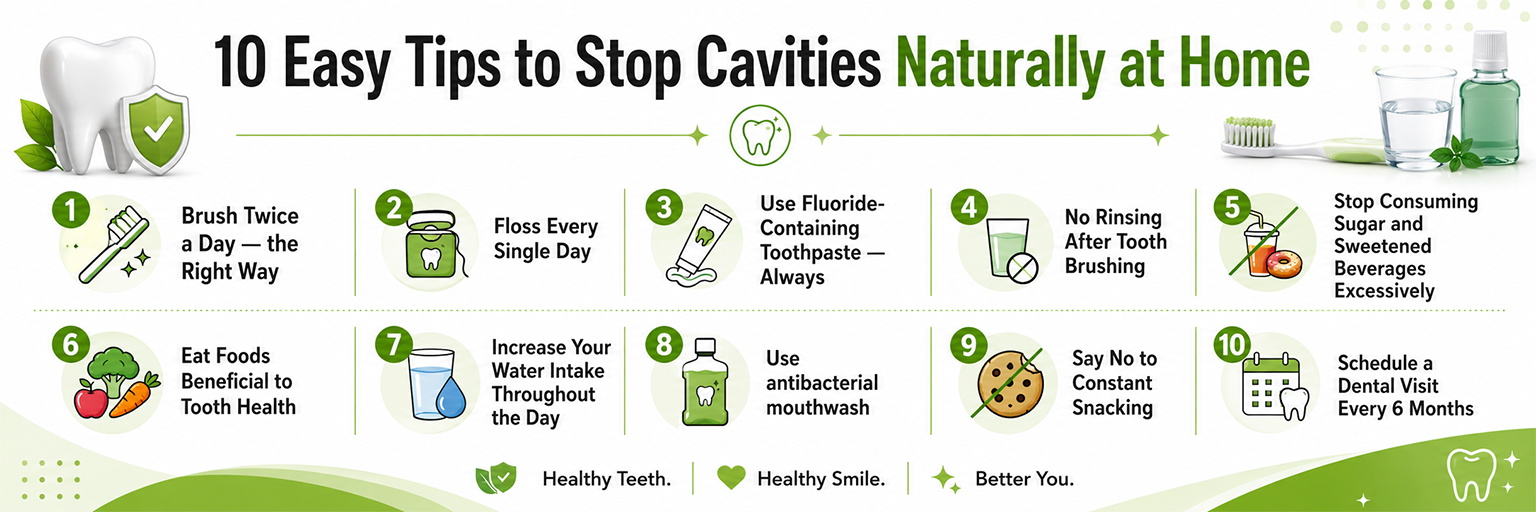
Tooth cavities don’t develop overnight, it develops because of our bad daily habits. Here are 10 effective tips to stop cavities. These tips are simple and can be easily followed on a daily basis at home.
1. Brush Twice a Day — the Right Way
Brush your teeth with a soft bristle toothbrush and a toothpaste that contains fluoride. Spend about 2 minutes brushing in the morning as well as before you hit the bed. Point your brush to the gum line at about a 45-degree angle to get rid of plaque the most where it accumulates. Every 3-4 months, change your toothbrush with a new one.
2. Floss Every Single Day
Usually, cavities start off from the spots between two teeth where a toothbrush cannot touch. At least once a day, floss to eliminate plaque and food that can remain hidden inside such spaces. In case you do not have any floss, a small interdental brush or a water flosser can be handy too.
3. Use Fluoride-Containing Toothpaste — Always
Besides strengthening the tooth, fluoride can stop the works of decay and even very early decay can be reversed with its help. Dental experts suggest one should always use a fluoride-containing toothpaste. Besides that, it is a trivial but very effective habit.
4. No Rinsing After Tooth Brushing
Never rinse with water/toothpaste after tooth brushing. Flushing by rinsing can remove your tooth’s protective coating of fluoride that has just been applied. One only change in behavior can greatly improve your protection from tooth decay.
5. Stop Consuming Sugar and Sweetened Beverages Excessively
The reason cavities develop is because sugar essentially nourishes the harmful bacteria. Right after every time sugar is ingested, these bacteria multiply and produce a sticky coating called plaque; this plaque then releases acid that lasts on enamel for 20-30 minutes corroding it from time to time. And the foods or drinks such as soft drinks, sweets, juices, white bread, and processed snacks are the ones which have the most sugar and should be the ones you reduce first in your diet. So cut down how often you have them, not just how much.
6. Eat Foods Beneficial to Tooth Health
- Milk, paneer, curd, excellent sources of calcium, which help to rebuild tooth enamel
- Apple, carrot, cucumber, there are enough bite-sized, tasty and healthy vegetables and fruits that also happen to be good for your teeth too
- Leafy greens and nuts, and rinse your mouth with plain water after having them.
7. Increase Your Water Intake Throughout the Day
Besides washing off food particles, water also helps neutralize acids and promote the production of saliva. Saliva is our mouth’s natural defence mechanism against tooth decay. It counteracts acid and helps to repair enamel non-stop. Therefore, water is the best beverage you can choose for your teeth.
8. Use antibacterial mouthwash
A fluoride or antibacterial mouthwash can reach those areas of your mouth that cannot be reached by a toothbrush, help to get rid of harmful bacteria, and greatly reduce your overall risk of getting cavities. Use it as a supplement to brushing, not a replacement.
9. Say No to Constant Snacking
Every time you eat or sip a beverage, the bacteria that live in your mouth go to work, producing acids that attack the tooth surface for 20-30 minutes. Frequent snacking means that your teeth are exposed to acid attacks almost continuously. Don’t snack between meals, and if you do, rinse your mouth with water afterwards to neutralize the acids quickly.
10. Schedule a Dental Visit Every 6 Months
The cleanings performed by professionals belong to a class of procedures that eliminates tartar which has become hardened and cannot be removed by a toothbrush. Moreover, regular dental appointments give a chance for the dentist to detect cavities at an early stage before the patient experiences any pain or has to spend a lot of money for treatment. At InSmile, we provide flexible appointment options both on weekdays and weekends to suit your schedule.
Also Read: 10 Signs You Need a Root Canal Treatment Immediately
Your Simple Daily Routine for Cavity-Free Teeth
|
Morning |
During the Day |
Night |
|
✓ Brush 2 mins with fluoride toothpaste ✓ Floss between all teeth ✓ Use mouthwash ✓ Drink water with breakfast |
✓ Choose water over sugary drinks ✓ Limit snacking between meals ✓ Rinse with water after eating ✓ Avoid sticky or hard sweets |
✓ Brush thoroughly — never skip ✓ Floss carefully ✓ Use mouthwash if recommended ✓ Nothing to eat/drink after brushing |
Cavity Stages: When Is It Still Reversible?
Understanding where your cavity is determines your treatment options. The earlier it is caught, the simpler and more affordable the solution.
|
Stage |
What is Happening |
Symptoms |
Treatment Needed |
|
Stage 1: white spot |
Enamel starts losing minerals |
None visible |
Fluoride + better hygiene – no drilling |
|
Stage 2: Enamel cavity |
Small hole forms in enamel |
Mild sensitivity possible |
Simple tooth-coloured filling |
|
Stage 3: Dentine Decay |
Decay reaches a deeper layer |
Sensitivity to hot/cold/sweet |
Filling or onlay- prompt treatment |
|
Stage 4: pulp involved |
Bacteria reach the nerve |
Toothache, throbbing pain |
Root canal treatment (RCT) |
|
Stage 5: abscess/loss |
Severe infection or tooth dies |
Severe pain or numbness |
Extraction + Dental implant |
This is why a routine checkup every 6 months is not just a recommendation — it genuinely saves teeth and money.
Common Oral Hygiene Mistakes That Cause Cavities
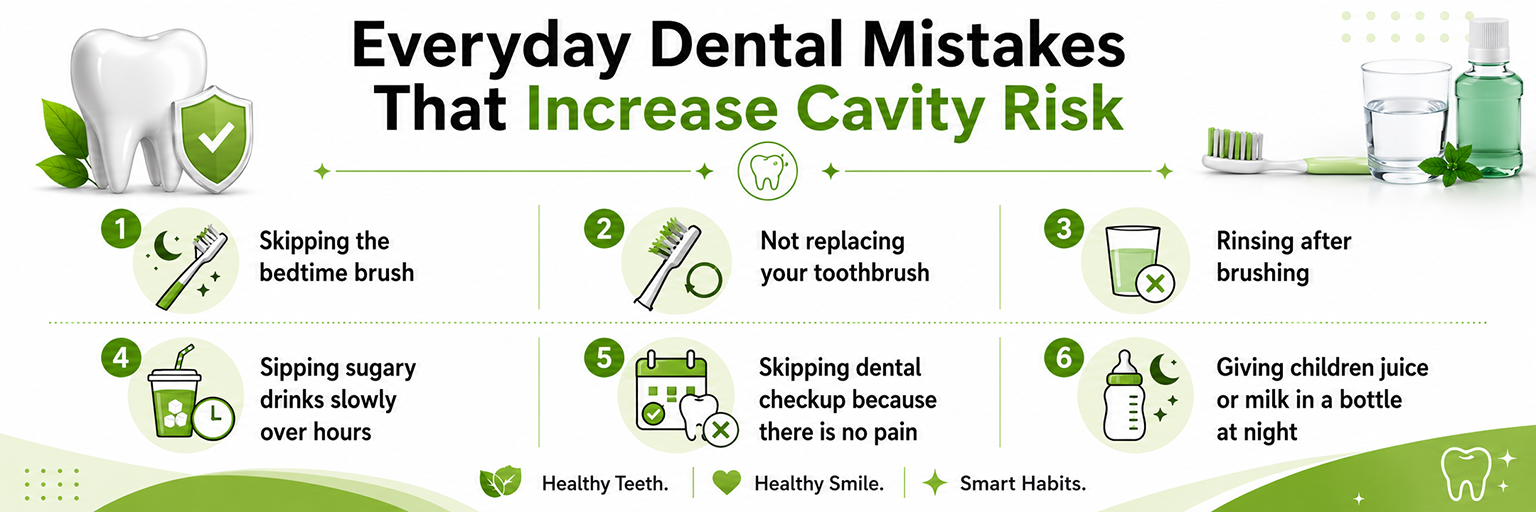
Here some daily habits that are quietly damaging your teeth:
- Skipping the bedtime brush: sliva drop at night, leaving the teeth defenceless for 8+ hours
- Not replacing your toothbrush: a worn brush barely removes plaque,thus replace your brush every 3-4 months.
- Rinsing after brushing: washes away the protective fluoride film, so just spit and do not rinse
- Sipping sugary drinks slowly over hours: extends acid exposure far longer than drinking quickly
- Skipping dental checkup because there is no pain: most early cavities are completely painless
- Giving children juice or milk in a bottle at night: this is the leading cause of dental decay in childhood
Conclusion
Since your teeth are a vital part of your body, you need to be able to protect them very well and one of the things that you can do is maintain a good oral hygiene routine of brushing and flossing daily. Along with this, you should avoid sugary drinks and junk food, take foods which are good for the teeth and go to the dentist twice in a year.
At InfiSmile Dental Clinic in Surat, Gujarat we are fully prepared to give you a hand no matter what stage you are in, from a simple filling to a full smile makeover. We have been working for 18+ years, use modern technology, and have a team that genuinely cares about patients, so we are able to make every visit as comfortable as possible.
Frequently Asked Questions
Can a cavity heal on its own without treatment?
Very early enamel damage (a white spot) can be reversed with fluoride and improved home care — but once a hole has formed, it cannot heal itself and needs professional treatment. Waiting makes it worse and more expensive to treat. At InSmile, we restore teeth quickly and painlessly.
How often should I visit the dentist to prevent cavities?
Every six months is the standard recommendation — once for a checkup and once for a professional cleaning. If you are cavity-prone or have children in their early years, more frequent visits may be advised. InSmile offers flexible weekday and weekend slots.
Are dental fillings at InSmile painful?
No. At InSmile Dental Clinic, all fillings are performed using local anaesthesia and gentle techniques. We use tooth-coloured composite materials — no metal, no visible filling. Most patients are surprised by how comfortable the experience is.
My child has cavities. What should I do?
Children are particularly prone to cavities due to their diet and developing hygiene habits. Our pediatric dentistry team at InSmile is trained to work gently with young children. We offer child-friendly checkups, fluoride treatments, and sealants — along with practical guidance for parents.
Is root canal treatment really painful?
This is one of the most common fears we hear — and one of the most outdated myths in dentistry. Modern RCT at InSmile is performed under local anaesthesia and is no more uncomfortable than a routine filling. In fact, it relieves the pain caused by the infection. Most of our patients are pleasantly surprised.
Very early enamel damage (a white spot) can be reversed with fluoride and improved home care — but once a hole has formed, it cannot heal itself and needs professional treatment. Waiting makes it worse and more expensive to treat. At InSmile, we restore teeth quickly and painlessly.
Every six months is the standard recommendation — once for a checkup and once for a professional cleaning. If you are cavity-prone or have children in their early years, more frequent visits may be advised. InSmile offers flexible weekday and weekend slots.
No. At InSmile Dental Clinic, all fillings are performed using local anaesthesia and gentle techniques. We use tooth-coloured composite materials — no metal, no visible filling. Most patients are surprised by how comfortable the experience is.
Children are particularly prone to cavities due to their diet and developing hygiene habits. Our pediatric dentistry team at InSmile is trained to work gently with young children. We offer child-friendly checkups, fluoride treatments, and sealants — along with practical guidance for parents.
This is one of the most common fears we hear — and one of the most outdated myths in dentistry. Modern RCT at InSmile is performed under local anaesthesia and is no more uncomfortable than a routine filling. In fact, it relieves the pain caused by the infection. Most of our patients are pleasantly surprised.